|
It was a BEAUTIFUL day at the beach in Bandon, and HOT, which is a rarity. I arrived at the Jetty around noon. There were several people perch fishing in the surf, and lots of agate hunters.
|
 |
| There was a slight haze to the air, though it is difficult to see it in the photos. It wasn't as thick as mist or fog...but it did affect visibility somewhat. I am not sure what causes that but I have experienced it before on the coast on warm sunny days. |
 |
| The little blue specks on the rocks are actually tiny dried dead jellyfish. It was hard to get my phone to focus on them close up. They looked almost like part of the rock at first. |
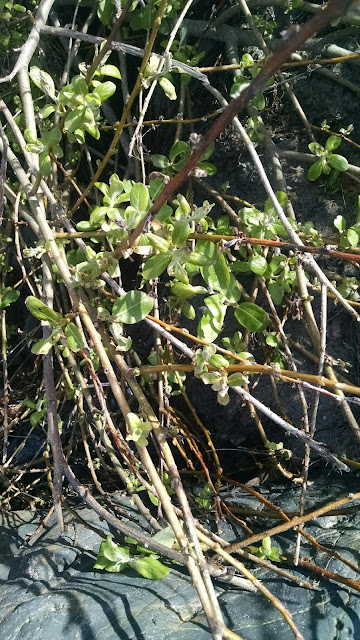 |
On the cliffs at the edge of the beach, the sand changes to large gravel and boulders and then to land; I photographed a scraggly willow trying to grow out of a rock bank.
|
 |
| Most of the slopes are covered in nasty, nasty gorse. |
 |
There was a variety of early successional species of algae, lichen, moss, and other small vegetation growing on this rock. I call this cave the "wind tunnel" because at times the air whips through there at incredible speeds. However, it was fairly calm on this day.
|
 |
I tried to climb up a little ways to photograph this little ledge which features some slightly later successional species on it, but this was as close as I could get.
|


 |
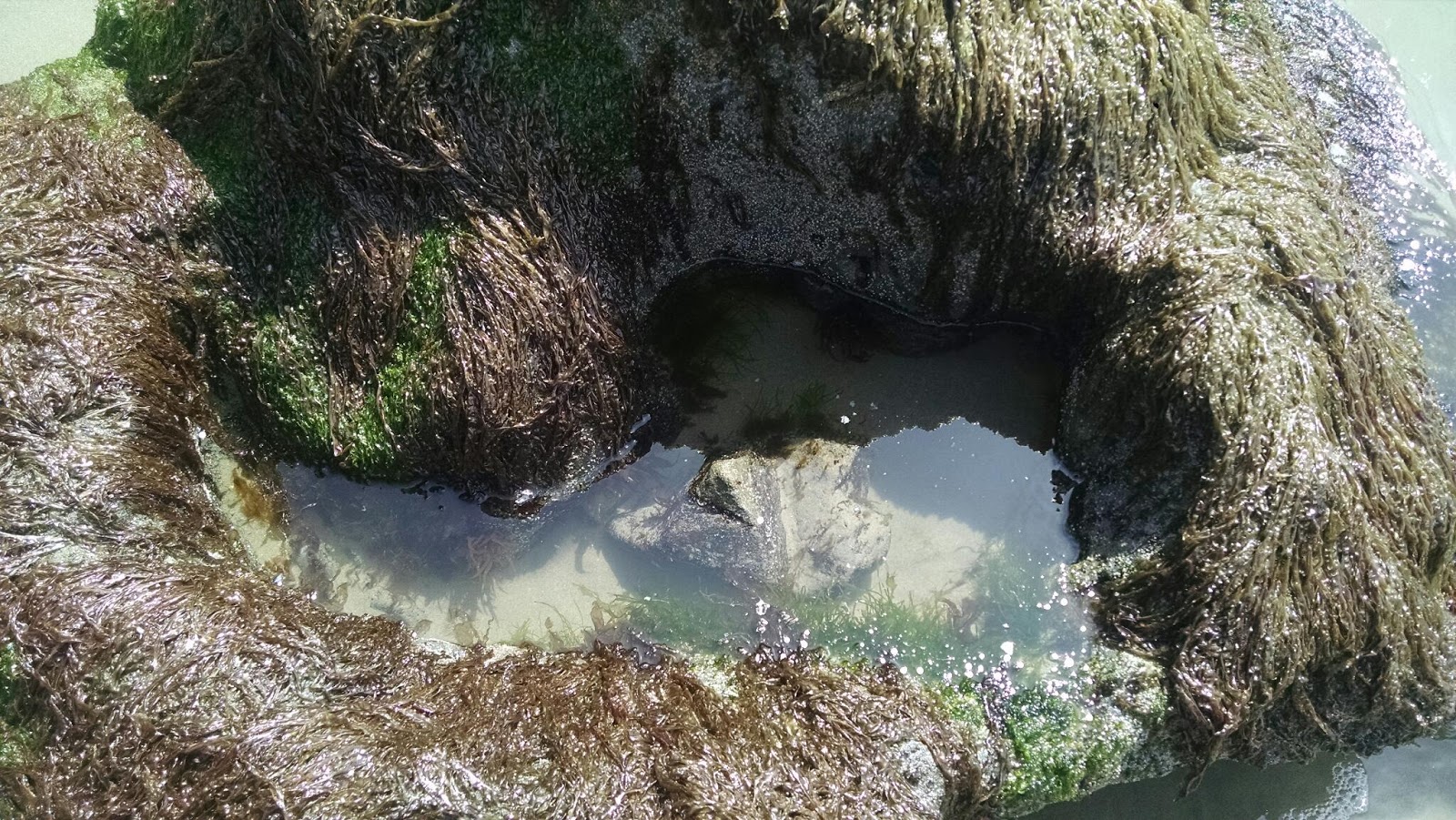
| I looked for some decent tidepools, but the tide was too high. I will have to return at a very low tide to get some better examples. These were found just south of Face Rock. |
 |
| I did not note any crabs or fish in these, although I thought there might have been some very small sea anemones hiding under the ledge. Unfortunately I did not have enough time between waves to take a very close inspection. |


 |
A female seagull was sitting on the sand in the middle of the beach. I thought maybe she was wounded; it seemed odd for a seagull to just nest down right in the middle of the beach like that especially with all of the people that were out that day. She stood up as I tried to approach, but this was as close as I could get. She did not fly away but I felt like I shouldn't harass the bird.
|
 | ||
| One of my favorite things to do in the spring is go clamming at Charleston Bay. This photo is taken looking out over the mudflats from the parking area. The best time to go is a minus tide, but on this day the low tide peaked at 1.9 ft, 3:19PM.
|
 |
| A closer view of the mud flats, looking towards the bridge. |
 |
| We use a rake to find cockles in the small tidal stream that runs across the flats. You are allowed up to 20 clams a day; this can be 20 cockle shell clams, or up to 8 Gaper clams and 12 Cockles. |
 |
| Danny is tired from raking clams. |
 |
| Digging for Gapers is nearly impossible with Seth on my back! Gapers can be buried over 4 ft deep in the sand. A trick to finding them is to look for a nice little hole in the sand (about 3/4"-1" in diameter) and stick a long dowel or an arrow down into the hole. When you feel it hit something hard, you know you've struck a clam. Then you dig with your shovel, not right down the clam hole, but off to the side, to the approximate depth of the clam. Then you dig over sideways to catch it unawares. You wouldn't think these little buggers can move very quick but they can. Also, when using a shovel, dig carefully as you near the clam so as not to chop the necks off or crush their shells. I consider it a point of pride to extract my clams from their sandy lairs in one whole piece; but I still decapitate or smash one every now and then. It's an art form, really. Another tip: where there's one clam, there is usually another nearby :-) |
 |
| One of my abandoned clam holes. As you can see, they fill up with water pretty fast which can make finding the clam harder because you can't see. Dig fast! |
 |
At the end of the day we had three different species of clams:
The large ones in the above photo are the Gaper Clams, also called a Horseneck Clam (Tresus nuttallii and Tresus capax):
either of two species of bivalve mollusks of the family Mactridae. An unusual fact about Gapers is that each one contains a tiny crab (sometimes a pair of crabs) with a translucent shell called a pea crab (Pinnixa faba). Once settled, mature females grow too large to leave and spend the rest of their lives in the clam. Males, which are markedly smaller, move from clam to clam throughout their lives. You will notice them scurry out as you clean your clams.
The clams with the ridged shells are called Cockles (Clinocardium nuttallii).The most common cockle found in Oregon is the "Heart cockle".
This common name relates to its scientific name Clinocardium nuttallii. Translated from Latin this name means "Nutall's sloping heart". The species name "Nuttallii" comes from the person who first described the species. Thomas Nuttall was a well respected botanist, orinthologist, and explorer of the 19th century. While exploring the Pacific Northwest in an 1830s expedition, the heart cockle was among the specimens he collected and described.
|
 |
| Littleneck, Leukoma staminea
Littleneck clams are a much sought after clam. They are found in rocky or gravelly areas of high, stable salinity. These clams are often confused with Manila littleneck clams, a smaller related (but non-native) clam that is farmed in mariculture operations and is available on local markets. Only Coos, Yaquina, and Tillamook bays have populations. We only found 3.

|